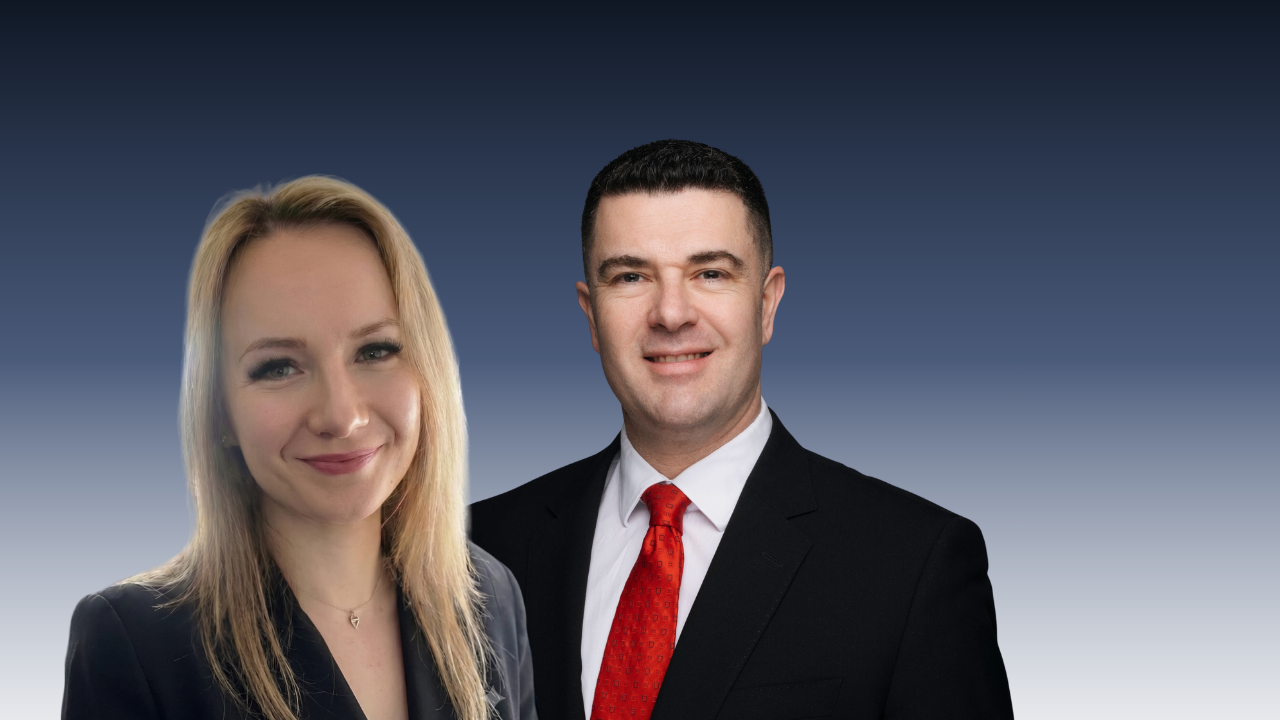
In a financial market where many still struggle to find truly transparent and sustainable guidance, Calyvia was born from the vision of Laurine Guisset and Tristan Fava: to put meaning back at the heart of wealth management.
After years working alongside investors, they saw the same frustrations arise time and again: too many people to deal with, not enough listening, and decisions driven by products rather than the lives of families.
So they envisioned a firm on a human scale, inspired by family offices but accessible, with a LUMIA model designed to give clients a clear and sustainable roadmap.
It is this more coherent and human vision that they share in this interview.
What shared vision guided you in creating Calyvia, and what did you want to reinvent in the way we support high-net-worth clients?
We created Calyvia with a simple conviction: wealth management must return to being a profession that aligns interests, not one that simply distributes products. After years in asset management and supporting investors, we felt that many high-net-worth clients were faced with a fragmented and unsatisfactory offering.
On one hand, opaque private banks, where advisors change frequently, listen little, and are incentivized to sell the “solution of the moment” rather than build a long-term strategy. On the other, 100% digital platforms—affordable but standardized—that struggle to account for the complexity of a real-world wealth situation: business ownership, professional assets, family dynamics, taxation, succession planning…
With Calyvia, we wanted to offer an alternative: the quality of analysis and management provided by a family office, but accessible starting at €100,000, rather than several million. In practical terms, this means a comprehensive view of the client’s wealth, coordination with the client’s other advisors (accountant, notary, lawyer), and long-term management.
We have reimagined the support process: a comprehensive assessment, a clearly explained wealth strategy, asset allocation aligned with life goals, and implementation and ongoing monitoring. With an open-architecture approach, we search the entire market for the solutions we deem best suited to the client’s situation. The client does not receive a product catalog, but a well-reasoned wealth plan, where every decision—financial, legal, or tax-related—is clearly aligned with their goals.
Wealth management advice is becoming increasingly comprehensive. How do you combine financial, tax, and people-focused expertise to offer truly coherent and transparent support?
For us, quality wealth management advice means organizing complexity for the client, not passing it on to them. It’s not about piling on financial, tax, and legal technicalities, but about structuring them around their reality: their family, their career, their plans.
Wealth management advice only makes sense if it is approached holistically. An investment may be perfectly designed on paper, but it can be ineffective—or even counterproductive—if it is not aligned with the client’s tax situation, family circumstances, or life timeline.
In practice, we begin with an in-depth consultation: professional situation, wealth history, risk tolerance, and concerns (protecting a spouse, securing children’s education, preparing for a business sale, etc.). It is this human context that gives meaning to the strategy.
Based on this, we develop quantified scenarios that combine:
- an asset allocation tailored to the time horizon and risk tolerance;
- a relevant legal and tax framework;
- a timeline: what do we do this year, in 5 years, at retirement, or upon a business sale.
We place a central emphasis on education: translating options into concrete impacts, so that the client can make informed decisions. When necessary, we work in coordination with their accountant, notary, or attorney, so that everyone is aligned on the same roadmap.
Your proprietary LUMIA method structures your approach. How does this framework provide a concrete benefit to clients in building their wealth strategy?
LUMIA is our proprietary asset allocation model, which took us several months to develop. It is inspired by the Black-Litterman model, originally developed by Goldman Sachs, which combines market data with our own economic views. In practical terms, it allows us to start with what the market “says,” integrate our macroeconomic scenario, and then derive target allocations by asset class.
This model is at the heart of our approach, as it allows us to analyze hundreds of investment products (funds, ETFs, fixed-income products, private equity, real estate, etc.) and make a quantitative pre-selection based on three factors:
- our economic scenario;
- market data (volatility, correlations, risk contributions);
- the client’s profile and objectives.
On this basis, we add a qualitative layer: we look beyond the numbers to select management teams that demonstrate vision, discipline, transparency, and consistency. We also pay close attention to the fee structure of each investment vehicle to build portfolios that aren’t buried under costs and don’t unnecessarily erode performance.
For the client, the benefit is tangible: they receive a robust, truly diversified portfolio tailored to the current economic cycle, rather than a simple collection of investment vehicles. In periods of high volatility, this methodology truly comes into its own: allocation decisions are not based on momentary intuition, but on a structured framework that is adjusted over time. Emotional biases are thus reduced, and this reinforces the strategy’s resilience over time.
In a highly competitive market, what do you believe makes the difference in the quality of a lasting client relationship, and how do you lay the groundwork for that trust from the very first interactions?
What makes the difference is the ability to truly put yourself in the client’s shoes, even when that means telling them to do nothing or to do less. A lasting relationship isn’t built on a one-off performance, but on the conviction that their interests are being defended over the long term.
From the very first interactions, we spend a lot of time listening: where the client comes from, what decisions have shaped them, what their fears are (losing capital, running out of cash, making the wrong choices for their children), and what their relationship with money is like. This human dimension is just as important as the numbers. Furthermore, we establish a framework of transparency from the outset: regarding our role, our compensation structure, our level of involvement, and the risks associated with each recommendation.
We reject the “instant connection” approach followed by a quick sale. Our process unfolds in several stages: assessment, feedback, reflection time, implementation, and then regular follow-up. This gives the client the space they need to envision the future, ask questions, and challenge our proposals.
Over time, trust is built on three elements: consistency between words and actions, responsiveness at key moments (whether the news is good or bad), and maintaining the same high standards, whether markets are booming or turbulent.
By founding Calyvia, you chose an independent model without proprietary products. How do you ensure a selection that is completely objective and truly aligned with each client’s goals?
When we founded Calyvia, we chose an open-architecture model with no in-house products, and we own 100% of our capital. The financial industry is rife with fees that are sometimes hidden, and it is very difficult for an investor to understand all the layers of fees charged depending on the investment vehicles chosen. That is why, in our LUMIA method, we have built in a specific fee filter: if an investment vehicle is too expensive relative to the return it can reasonably offer, it is simply not selected.
Regarding our own compensation, we give the client a choice between two options:
- billing based on clearly defined advisory fees;
- or a flat fee applied to the invested assets.
In all cases, fees are adjusted to the complexity of the cases and the amounts involved, and their details are communicated, explained, and approved before any implementation—no surprises. Regarding the flat fee we charge, we have set a clear objective: taking into account the retrocessions we may receive from asset management companies, the total cost to the client must be, on average, half that of private banks and traditional players.
Clients thus benefit from a truly open architecture and controlled fees that are genuinely aligned with their interests.