"High-yield" bonds, also known as "high-yield" bonds in financial jargon, offer three key benefits within a portfolio: lower volatility than equities, generally attractive yields, and a source of diversification that complements longer-duration assets, thereby helping to limit the portfolio’s exposure to interest rate volatility. In this note, the second in a series on bond management (the first, on investment-grade corporate bonds, is available here), Capital Group examines the structural factors underpinning the high-yield bond segment.
Over the past five years, financial markets have been marked by several exceptional shocks, including the Covid-19 crisis in 2020, aggressive rate hikes by central banks beginning in 2022, and increased tariffs in 2025. Despite these disruptions, Capital Group notes that the high-yield segment has performed remarkably well, emerging as the best-performing segment of the bond market.
Since 2020, the high-yield bond segment has outperformed most other bond asset classes
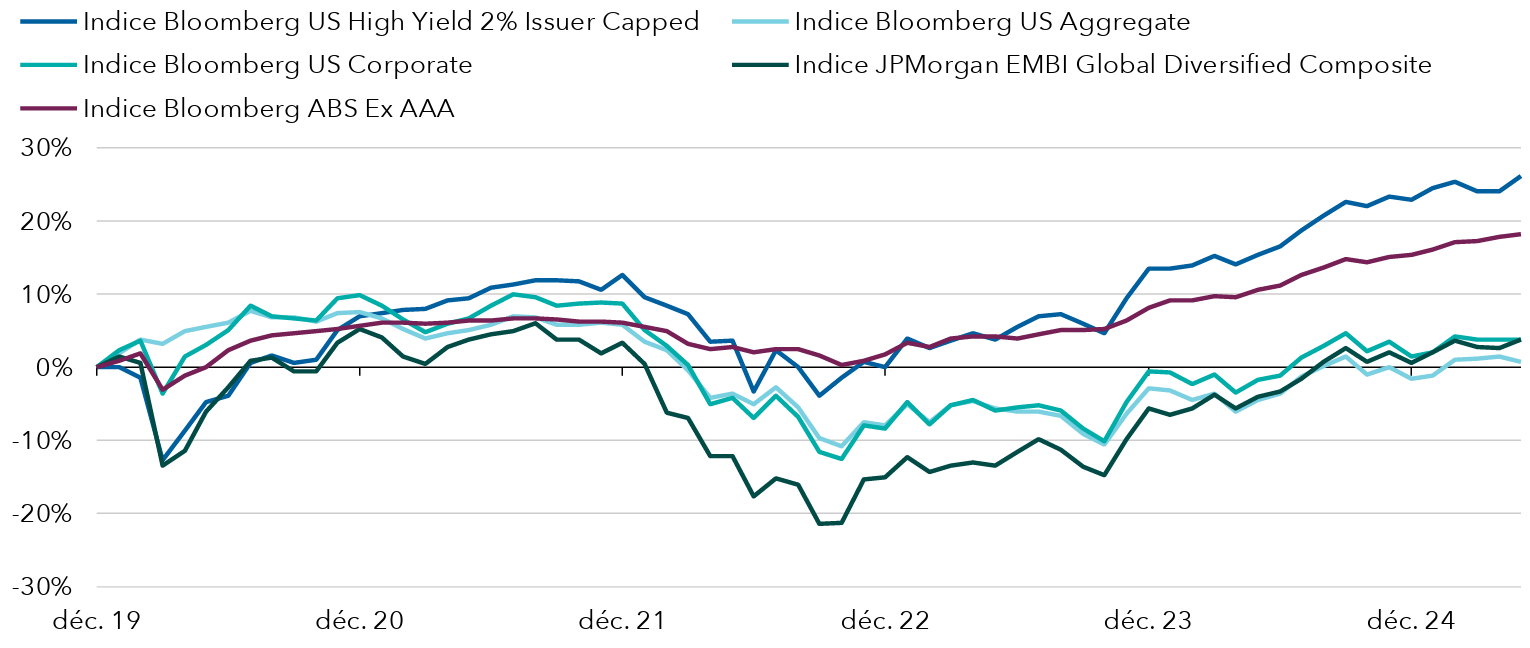
Past performance is not indicative of future results. Data as of May 31, 2025. Source: Bloomberg.
Improved fundamentals and rising quality
Clearly better equipped to weather shocks following its structural transformations, the high-yield bond segment should have a bright future ahead. These various strengths also explain, at least in part, the relative narrowness of credit spreads compared to their long-term historical averages—a trend that is likely to continue in the absence of an exogenous shock.
Since the 2008 financial crisis, companies have shown greater discipline in managing their debt. This trend has helped raise the credit quality of issuers in high-yield bond indices, over 50% of which are now composed of BB-rated bonds (the segment’s highest rating).
Managed maturities, a more selective market
The high-yield bond maturity calendar (maturing securities, expected new issues) also remains under control. A significant portion of the maturities scheduled for 2025 and 2026 has already been brought forward, with less than 3% of the high-yield segment needing to be refinanced by the end of the year.
Since “Liberation Day” (the White House’s announcement of new tariffs) in early April 2025, the high-yield bond market has reached levels of dispersion not seen in the past five years. This situation offers active management specialists multiple opportunities to find value.
To learn more:
About Capital Group:
Founded in 1931, Capital Group invests with a long-term approach in the best interests of its clients. The firm has 94 years of experience, over $3 trillion in assets under management (as of June 30, 2025), 32 offices in 15 countries, and over 9,300 employees, including 363 portfolio managers and analysts with an average tenure of 21 years. Its proprietary model, The Capital System™, combines a diversity of perspectives with decisions based on the strongest convictions.